- Frill Free Horticulture
- Growing Ornamental Plants
- Plant Propagation
- Dividing Perennials
Jacki Cammidge is a Certified Horticulturist specializing in frugal, low-input gardening and propagation, with lifelong hands-on experience and years as a wholesale nursery head propagator.
Dividing Perennials
How to Make More Plants by Division
Did you know you can increase the number of plants for your garden exponentially by dividing perennials? They are very easy to divide by cutting parts of the main plant off, or splitting the whole thing into many more pieces, each producing an entire new plant.

Division of plants will provide you with several identical plants. These are known as clones, unlike growing them from seed which will always give you individually unique plants (even if they look similar to you).
You will need some basic tools; a garden fork (or two, to make it even easier) or a spade, and maybe a large knife, like a machete. This makes it possible to get deep into the core of the mother plant and chop down to cut it into pieces.
 Dividing perennials with a garden fork; first dig it out, or partially, then split down the center of the crown to divide it into pieces
Decide how many pieces your plant can be cut into. Odd numbers are best, so five, seven etc. These make the final planting look much more natural. And of course, you will stagger the plantings, and group them as they would occur in nature, not in a row of soldiers or symmetrically.
How to Divide Perennials
First, dig out the plant, or at least a side of it. If it's too big you may have to do it in stages until it's down to size. Cut off a section with the knife, or use the spade and fork, back to back so you can pry the pieces apart.
This is going to be the only way with plants like Hemerocallis, which make a dense mat of roots and tubers.
Each piece will quickly make a new plant, either spaced out away from each other in the bed, or moved to a nursery bed or even a container.
 Where to cut; follow this diagram to cut perennials into sections - each one will have roots and a section of the crown, and be identical to the other pieces. Notice that there is an odd number.
Plants like Iris which have large tubers and chunky roots can be pulled apart rather than cut. This will help them become established quickly rather than rot from the damage to the tuber.
This list of perennials that will be okay to divide is not extensive, but you will notice that they're all similar in structure.
They all have a crown that expands outwards with new growth, so cutting it into pieces makes it possible to have roots and a portion of the crown.
Sedum (Hylotelephium)
Alchemilla mollis
Hosta
Helenium autumnale
Platycodon
Heuchera
Rudbeckia hirta
Monard didyma
And any other clump forming perennial.
When Is a Good Time To Divide Perennials?
For timing, generally it's best to do this process early in the spring, for a couple of reasons.
First, you can see what you're doing with less foliage on the plants, and also access the one you'll be dividing.
Also, with less growth, there will also be less damage to the plant when you're cutting through it. Having said that, any time is a good time; preferably just prior to a good soaking rain (so you don't have to water them) and also when it's not too hot.
Evening is the best time. Then the split plants will have all night to come to terms with their new situation, and if they've had a good drink, they'll adapt much quicker than if they are limp from dehydration.
Dividing perennials is one of the most economical ways to increase the number of plants. Rather than having only one of each plant you can quickly have a mature garden with drifts of one type of plant for a very impressive display of bright blooms or textural leaves.
You might like these
Plant Propagation Station - everything you need for success
Plant Propagation Station - everything you need to grow plants successfully, from seed to cuttings to repotting...
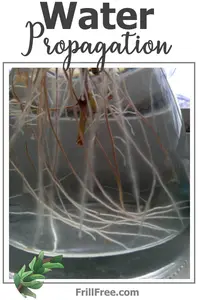
How to use water for propagation
Some plants are so easy to root in a jar of plain water, why wouldn't you use water propagation for growing more plants?
Best Rooting Hormone for Plants: What Works for Each Plant
Learn the best rooting hormone for plants based on cutting type, season, and strength, so you can avoid rot and boost rooting success rates.
 Jacki Cammidge
AUTHOR BIO
Jacki Cammidge is a Certified Horticulturist who helps gardeners grow more with less through low-input, budget-friendly gardening and propagation. She has gardened her whole life, served as head propagator at a wholesale nursery, and handled thousands of rose and juniper cuttings.
Readers can find her at Frill Free on Facebook and Pinterest. Her frill-free approach was forged in northern BC, where horse manure, leaves, salvaged sawdust, and a deer-tested raised bed built her garden from scratch.