- Frill Free Horticulture
- Gardening for Beginners
- Hedge
- Building a Dead Hedge
Jacki Cammidge is a Certified Horticulturist specializing in frugal, low-input gardening and propagation, with lifelong hands-on experience and years as a wholesale nursery head propagator.
Building a Dead Hedge
Use Prunings and Left Over Branches
Building a dead hedge will be one of the most interesting projects in your garden. Once you choose your spot and drive in the posts, the rest can be done over time, making them the perfect activity for a fall afternoon.
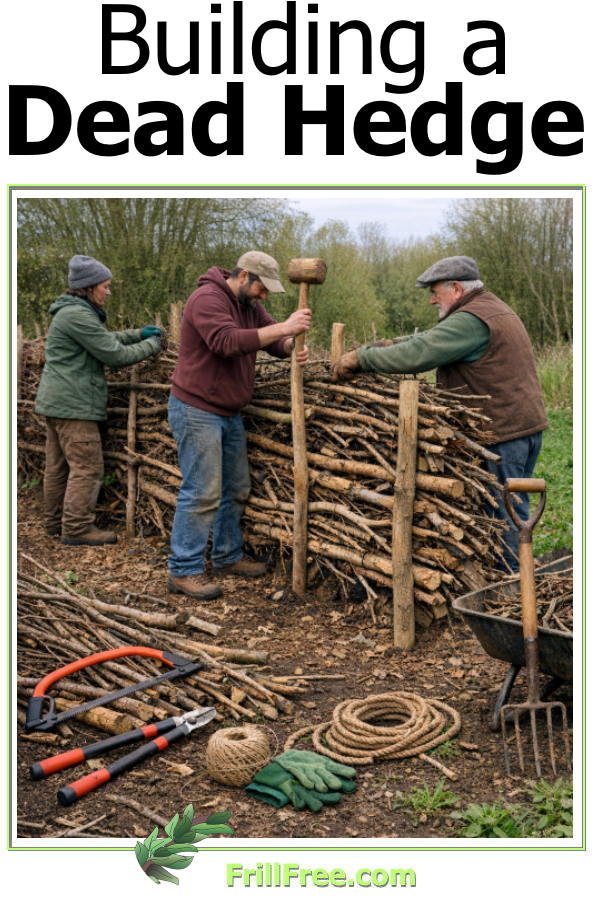
A dead hedge is a simple, wildlife-friendly boundary made by stacking cut branches and prunings between upright stakes. It’s called "dead" because it uses woody material that has already been cut, but in practice it creates a very lively habitat.
Instead of hauling away garden waste, you turn it into a natural screen, windbreak, and shelter for birds, insects, and small mammals.
Dead hedges are especially useful for solopreneurs and home-based growers who want a low-cost, attractive, and sustainable way to define spaces on a property.
Willow growers will often have left over rods and pieces that aren't suitable for baskets or any other purpose. Using them to build a dead hedge takes care of disposing of them, other than burning.
Building one is straightforward.
First, choose your line and mark out the length of the hedge.
Then hammer in sturdy wooden stakes in two parallel rows, leaving a gap between the rows that will hold the branch material.
Stakes are commonly spaced about 50 to 100 cm apart, depending on the size of the hedge and the materials available. The gap between the rows can be narrow for a neat, compact hedge or wider if you want a larger, looser structure.
The stakes can be long straight branches, 2x2 lumber, sharpened at the bottom, or even metal T-posts. If your ground is more mud than stones, use the last option.
Once the stakes are in place, begin laying branches, twigs, canes, and prunings horizontally between them. Mix thicker pieces with finer brush so the structure locks together. As you add material, press it down gently to keep the hedge stable.
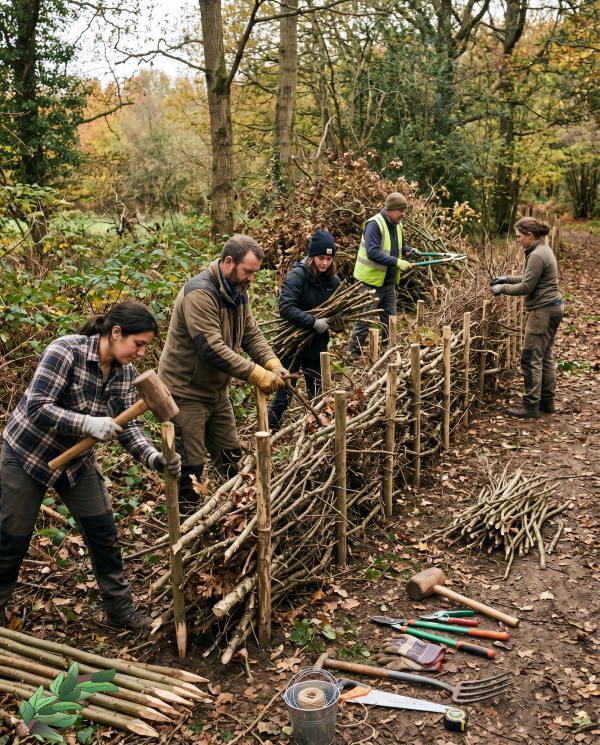 A team building a dead hedge
One of the best things about a dead hedge is that it can be built gradually, with a team of between one and six or seven people, depending on the length.
You don’t need all the material at once. Seasonal prunings from shrubs, fruit trees, hedges, and even raspberry canes can all be added over time.
This makes it ideal for a working garden, because the hedge becomes an ongoing recycling system. Instead of burning green waste or sending it away, you store carbon on site and create useful structure at the same time.
Dead hedges have strong ecological benefits. The tangle of wood provides nesting cover for birds, hibernation spaces for insects, and refuge for frogs and other small creatures where they occur.
As the lower layers slowly decompose, fungi and invertebrates move in, helping return nutrients to the soil. In this way, a dead hedge functions almost like a long, above-ground compost habitat.
It also softens wind, traps leaves, and can create a sheltered microclimate for nearby plants.
From a design point of view, dead hedges can be rustic or surprisingly tidy. A straight run with evenly spaced stakes looks intentional and can suit kitchen gardens, allotments, and permaculture sites.
Curved dead hedges can divide outdoor rooms or edge wildlife areas. Some gardeners even use them to protect young hedges by building a dead hedge alongside newly planted living shrubs.
Maintenance is minimal. Over time, the material settles and breaks down, so you simply keep topping it up with fresh prunings. If a stake loosens, replace or reinforce it.
The hedge will never look exactly the same from year to year, but that is part of its charm. It is practical, beautiful in a natural way, and deeply efficient.
A dead hedge shows how a garden can turn waste into value - something every resourceful builder or business-minded grower can appreciate.
Plan and anticipate any problems with building your dead hedge by looking over any pros and cons to make sure a dead hedge suits your garden.
What is a dead hedge?
What is a dead hedge?
Exactly as it sounds, a dead hedge performs the same function as a live hedge, but it's created from stakes in the ground filled with dead branches, brush and twigs.
What plants should I put in a dead hedge?
What plants should I put in a dead hedge?
You can use almost anything from your garden that would otherwise go into a burn pile, be chipped or sent to the landfill. If it once lived, you can add it to your dead hedge.
You might like these
Do Not Waste Water - conserve a precious resource in the home & garden
Do Not Waste Water; this precious resource is not infinite, and we need to conserve water in homes and gardens; learn how to effectivigly minimize water waste...
Carsen Andrew Memorial Garden; Trigger Warning - dealing with loss
Designing and planning the Carsen Andrew Memorial Garden is my way of staying sane when I lose a loved one, or in this case, two...,
Sustainable Gardening e-Book - organic gardening
Sustainable Gardening e-Book - guidelines for organic gardening...

 Jacki Cammidge
AUTHOR BIO
Jacki Cammidge is a Certified Horticulturist who helps gardeners grow more with less through low-input, budget-friendly gardening and propagation. She has gardened her whole life, served as head propagator at a wholesale nursery, and handled thousands of rose and juniper cuttings.
Readers can find her at Frill Free on Facebook and Pinterest. Her frill-free approach was forged in northern BC, where horse manure, leaves, salvaged sawdust, and a deer-tested raised bed built her garden from scratch.