- Frill Free Horticulture
- Gardening for Beginners
- Hedge
- Dead Hedge Pros and Cons
Jacki Cammidge is a Certified Horticulturist specializing in frugal, low-input gardening and propagation, with lifelong hands-on experience and years as a wholesale nursery head propagator.
Dead Hedge Pros and Cons
The Good, The Bad And The Ugly
If you already have a dead hedge, you've already decided that the benefits outweigh the disadvantages, so no need to ponder on the pros and cons of a dead hedge. But if you're still on the fence, this might help you decide if you can put up with any of the disadvantages.
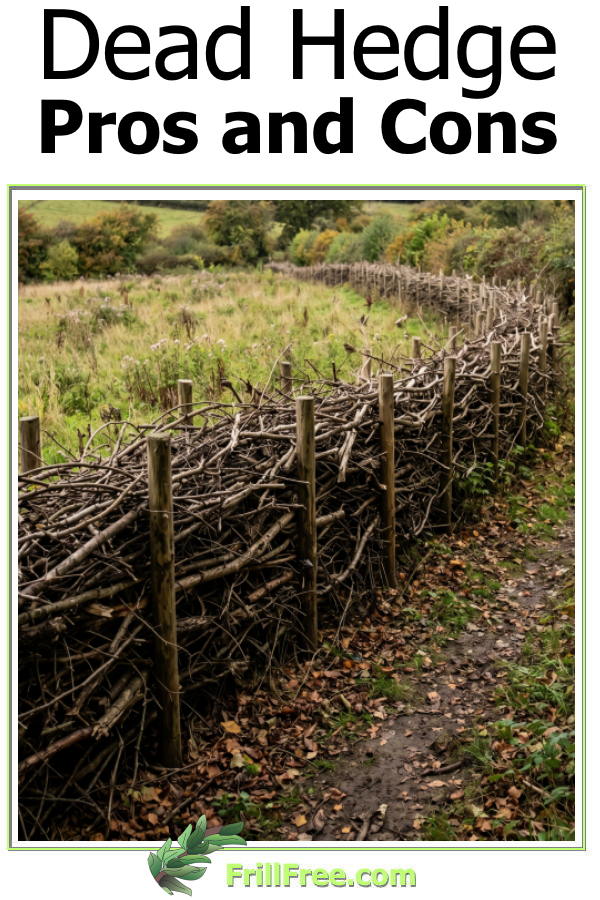
A dead hedge is a boundary made by weaving cut branches, brush, and prunings between upright stakes.
It is an old, practical way to use garden waste while creating structure and habitat. For gardeners, farmers and anyone else interested in wildlife-friendly landscaping, it offers a low-cost alternative to fencing or sending woody material away to be disposed of.
Like any feature, though, it has both benefits and drawbacks.
First of All, The Pros
Instead of burning, chipping, or hauling away branches, you reuse them on site. Woodlot managers and others recommend dead hedges as a way to recycle prunings and create wildlife habitat, making them useful in gardens that aim to reduce waste and support biodiversity.
They are especially handy after hedge cutting, tree pruning, or clearing shrubs, when a lot of twiggy material builds up quickly.
Another benefit is wildlife value. Dead wood is extremely important for many insects, fungi, birds, amphibians, and small mammals.
One major advantage of a dead hedge is sustainability.
A dead hedge can provide shelter, nesting material, safe corridors, and feeding opportunities.
Many gardeners have found that piles or structures made from dead wood can support beetles, sparrows, wrens, and other creatures. In a tidy modern garden, this kind of habitat can be surprisingly scarce, so a dead hedge can add ecological diversity with very little expense.
Another pro is affordability and simplicity. If you already have the materials, the main inputs are time and a few sturdy stakes. There is no need to buy panels, wire, or chemical treatments.
Dead hedges don't require a skilled crew to build, and can be done by anyone with reasonable strength to lift small amounts of debris and small branches. Once the uprights are in place, the rest of the building process is fairly simple.
Dead hedges can also look natural and attractive, fitting well in cottage gardens, permaculture plots, woodland edges, and informal landscapes.
They can mark boundaries, protect young plantings, screen compost areas, or divide spaces without feeling too harsh or manufactured.
And Now, The Cons
Dead hedges also have disadvantages. One is limited lifespan.
Because the material is already cut and dead, it gradually rots and settles.
Depending on the wood used, local climate, and construction, a dead hedge may need regular topping up or partial rebuilding. Hardwood branches may last longer than softwood, but maintenance is still part of the deal.
Another drawback is appearance. While some people love the rustic look, others see it as messy.
In formal gardens or urban neighborhoods with strict expectations, a dead hedge may not suit the setting. It can also become uneven over time as the material compacts or blows about in strong wind.
There can also be practical concerns. A dead hedge takes up more width than a conventional fence, which may matter in a small garden.
If your dead hedge plans have come to a grinding halt due to a lack of confidence in whether or not it's a good idea, I hope this list has given you some faith in your decisions.
The pros and cons of any project can make or break it, hopefully this one comes out on the side of the positive.
You might like these
The Circle of Thyme Chapel of St. Francis of Assisi
The Circle of Thyme Chapel of St. Francis of Assisi is a twig gazebo built on a whim for the clematis to clamber up - it was more successful than we ever imagined...
Recycling Carpet - a new use for old wall-to-wall
A new use for old wall-to-wall - Recycling Carpet into the perfect walkway mulch - cover with woodchips...
Guest Post - Pet Friendly Gardening
Guest post; How to Make Your Garden Safe for Your Pet - Pet Friendly Gardening...

 Jacki Cammidge
AUTHOR BIO
Jacki Cammidge is a Certified Horticulturist who helps gardeners grow more with less through low-input, budget-friendly gardening and propagation. She has gardened her whole life, served as head propagator at a wholesale nursery, and handled thousands of rose and juniper cuttings.
Readers can find her at Frill Free on Facebook and Pinterest. Her frill-free approach was forged in northern BC, where horse manure, leaves, salvaged sawdust, and a deer-tested raised bed built her garden from scratch.