- Frill Free Horticulture
- Growing Ornamental Plants
- Super Thrive
Jacki Cammidge is a Certified Horticulturist specializing in frugal, low-input gardening and propagation, with lifelong hands-on experience and years as a wholesale nursery head propagator.
Super Thrive
Magic? Or Just an Advertisement?
I used to use Super Thrive many years ago, then forgot all about it. Recently, I purchased a couple of little bottles, and it's changed my gardening life.
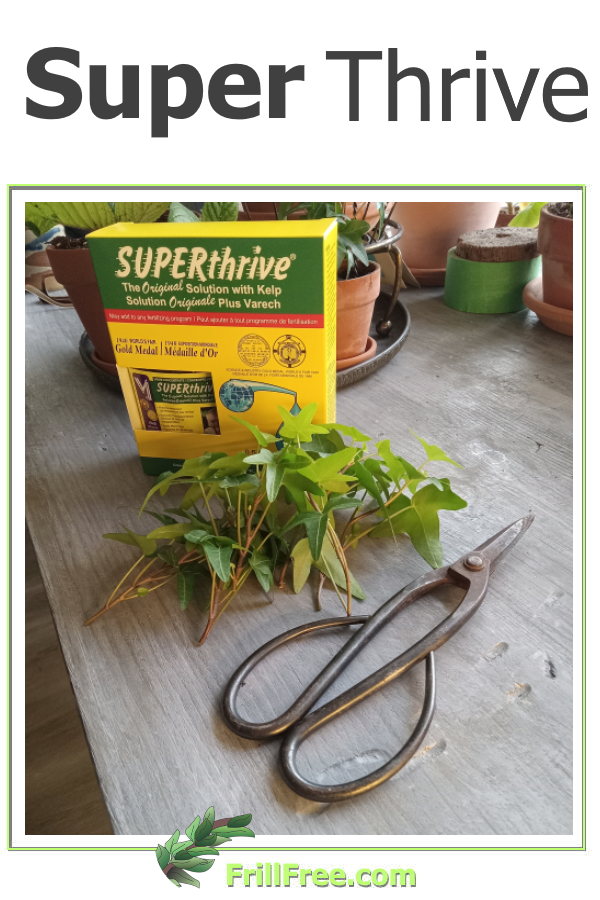
There are many sizes of Super Thrive. You can get small ones to try it, but I bet you will eventually buy a bigger bottle. The only drawback is the strong smell of Vitamin B, but once you see how this stuff works, you won't mind it a bit.
I had some tomatoes that were grown from seed, but then potted into some potting soil that was contaminated with Aminopyralid herbicide. To try to save them, I took them out of the soil, rinsed off the roots, then soaked them for a couple of hours in a weak solution of Super Thrive.
Then I repotted them into clean soil, watering them in with the Super Thrive water. A few days later I depotted two of them again, as they were still showing signs of Aminopyralid damage, and the root systems were astonishing. There was more than twice the roots than the first time they were depotted.
My next test was to take cuttings of some geranium seedlings - these were only a few months old, but needed to be pinched so as to make them bush out and become more compact.
I prepared the cuttings, letting them callous for a few hours.
Then I dipped them in rooting hormone, and stuck them into individual pots, something I seldom do because of the chance of losses.
I watered them from below as my growing system involves using small clay pots in a tub. I used Super Thrive diluted many times in water. The clay pots draw the moisture up using capillary action.
Four days later I gently tugged on one of the cuttings, and it was rooted. Four days! I've never had plants root that fast.
I credit Super Thrive with the majority of the success with these plants. I've used Super Thrive in a sprayer to spray on new seedlings, even on seeds yet to germinate.
I spray the leaves of any plants that seem to be struggling a bit, or on the soil of newly transplanted or repotted plants to help with root growth and to get them acclimated quickly.
This kelp based product is compatible with any watering or fertilizing regime, it's completely water soluble. I put a few drops into the watering can every time I water, especially for plants that are struggling to produce roots.
Apart from a rather strong smell of vitamin B, there isn't really any downside.
One thing I haven't tried is to put it into the water for those cuttings I'm rooting in a jar.
Time for another experiment!
Edit; I tried diluting Super Thrive in water for use rooting cuttings in jars, but found that it really didn't make any difference.
It was a good try! The cuttings, once rooted, did grow well in the soil, watered with a couple of irrigations with the Super Thrive, so I'll just keep using that method.
Edit again; it looks like Super Thrive has been discontinued, so if you find some, hoard it!
You might like these
Natural Fertilizer - eco-friendly nutrients for organic vertables
If you're growing organic vegetables, you'll need natural fertilizers to keep them healthy...
10 Best High Nitrogen Natural Fertilizers: Quick Results
Skip the guesswork: 10 best high nitrogen natural fertilizers ranked by release speed, availability, and odor—plus what to avoid in the garden.
Chicken Coop Compost - 10 best natural high nitrogen fertilizers
One of the ten best natural high nitrogen fertilizers - Chicken Coop Compost...

 Jacki Cammidge
AUTHOR BIO
Jacki Cammidge is a Certified Horticulturist who helps gardeners grow more with less through low-input, budget-friendly gardening and propagation. She has gardened her whole life, served as head propagator at a wholesale nursery, and handled thousands of rose and juniper cuttings.
Readers can find her at Frill Free on Facebook and Pinterest. Her frill-free approach was forged in northern BC, where horse manure, leaves, salvaged sawdust, and a deer-tested raised bed built her garden from scratch.