- Frill Free Horticulture
- Growing Ornamental Plants
- How to Water a Plant
Jacki Cammidge is a Certified Horticulturist specializing in frugal, low-input gardening and propagation, with lifelong hands-on experience and years as a wholesale nursery head propagator.
How to Water a Plant
in a Pot or Container
Plants growing in pots or containers require a bit more thought, both in the type of soil to use and how to water a plant that's in it.
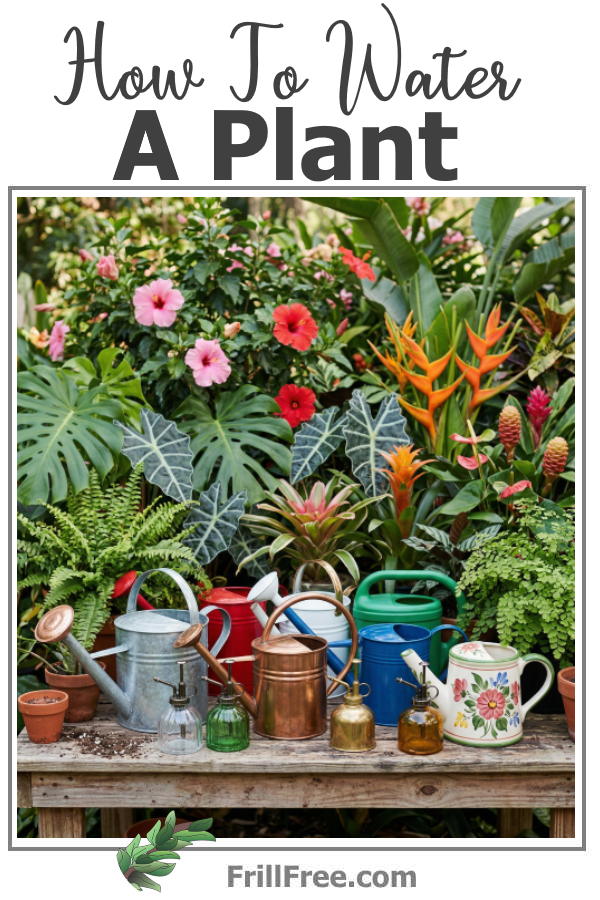
You may think it's easy to water a plant, you just splash a bunch of water into the soil and away it goes.
That's not entirely accurate. Even if your plant is growing in the correct soil for the type of plant, you could be doing it all wrong anyway.
Many plants need good drainage, they don't like any water around the roots at all. This would include any kind of succulent, and most if not all orchids, especially epiphytes, or those that grow in trees.
For most other plants, including ferns, African violets and many tropical foliage plants, they require a moist soil at all times.
So you can see that the regimen of watering for one will not be in the best interest of the other. It all comes down to where the plant originates.
Succulents live in droughty soils, with periodic flooding (or what I like to call, gully washers). The water drains quickly through the soil that most likely has a lot of sand or gravel in it.
On the other hand, plants that originated in jungle situations would have evolved to like a humid warm atmosphere, and soil that holds a lot of moisture due to the accumulation of composted leaves.
Ferns are a perfect example of this type of plant.
Orchids, like Phalaeonopsis and similiar species, originated growing in the crotches of tree branches, high in the air. The frequent rains would drain off almost immediately, and the soil, what there is of it, would have been a few teaspoons of humus from dead leaves collecting in the crooks.
So watering all these different kinds of plants places us in a predicament. If you like a wide variety of many kinds of plants, attempting to grow them all in the same place, it's going to be a balancing act to keep them all happy.
One way to do this is to group similar plants together, especially those with watering needs that are the same. This makes it much easier to water them on a differing schedule, or in a particular manner.
Sometimes plants that all require the same care could be grouped in a shallow pan and watered from below.
The way to water all these different plants is going to take some juggling, and a bit of experimenting with different types of watering cans, sprayers, misters and possibly even drip irrigation if you have a lot of plants.
There are a few things to remember; always use tempered (lukewarm) water for tropicals and succulents.
The best water is collected from the rain barrel, which doesn't contain any minerals or chemicals.
Second option is from your air conditioning unit or heat pump when it goes through a defrost cycle. This is essentially distilled water, so again, no added minerals that can collect in the soil and clog up the pores.
Always water lightly once, then come back and give a deeper watering. This allows the soil to soak it in, rather than allowing it to drain off quickly. Once the soil is swelled up from the first shallow watering, the second one has a chance to be absorbed.
Never let a plant sit in a saucer of water. Cache pots should be emptied immediately after the soil has absorbed as much as it can.
To water orchids, soak them in a deep container of water, then allow them to drain thoroughly.
See more about watering tropical plants here for a checklist.
You might like these
Starting a Gardening Business - make money homesteading
Make money with horticulture - by Starting a Gardening Business where you have complete control...
Redo Your Hanging Baskets for a refresh
Redo Your Hanging Baskets for a refresh...
Economy Hanging Baskets - beauty for less, all summer
Economy Hanging Baskets; there is no reason to spend lots of money on baskets and planters...
 Jacki Cammidge
AUTHOR BIO
Jacki Cammidge is a Certified Horticulturist who helps gardeners grow more with less through low-input, budget-friendly gardening and propagation. She has gardened her whole life, served as head propagator at a wholesale nursery, and handled thousands of rose and juniper cuttings.
Readers can find her at Frill Free on Facebook and Pinterest. Her frill-free approach was forged in northern BC, where horse manure, leaves, salvaged sawdust, and a deer-tested raised bed built her garden from scratch.