- Frill Free Horticulture
- Raised Bed Gardening
- 4x8 Raised Bed Planting Layout
Jacki Cammidge is a Certified Horticulturist specializing in frugal, low-input gardening and propagation, with lifelong hands-on experience and years as a wholesale nursery head propagator.
4x8 Raised Bed Planting Layout
Best Set Up For a Raised Bed
If you have raised beds, you may feel a bit baffled on how to start planting them. Here's where to start, with this 4x8' raised bed layout plan. You can adapt it to other sizes, but this is the most common dimension for your bed.
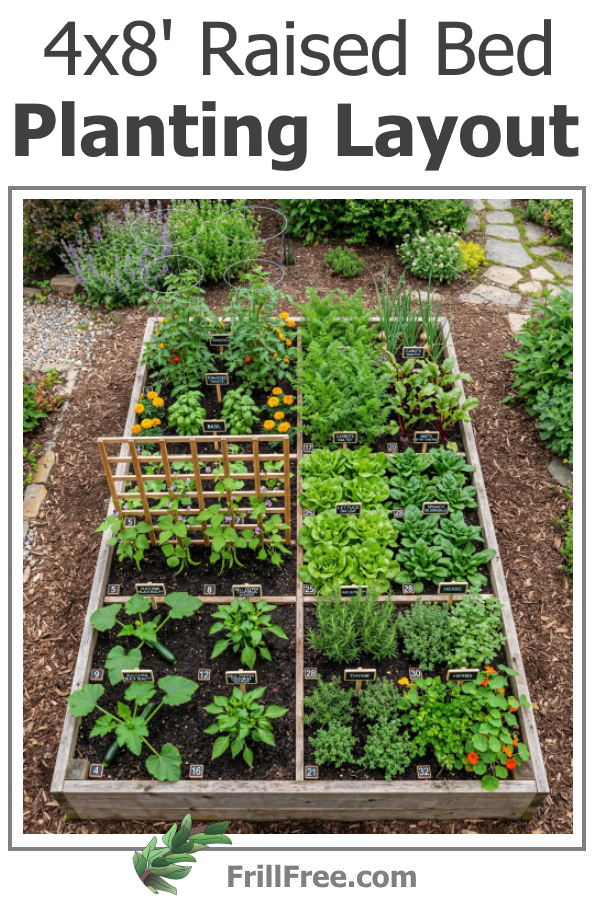
Here’s a simple raised-bed spacing chart for common vegetables and herbs.
Raised-bed spacing chart
Cool-season crops
- Lettuce
- Seed spacing: 1 inch
- Thin to: 6–12 inches
- Row spacing in raised beds: not needed; plant in blocks
- Spinach
- Seed spacing: 1–2 inches
- Thin to: 3–6 inches
- Block spacing: 4–6 inches
- Peas
- Seed spacing: 1–2 inches
- Thin to: usually not needed
- Block spacing: 2–3 inches with trellis
- Radishes
- Seed spacing: 1 inch
- Thin to: 2–3 inches
- Block spacing: 3 inches
- Carrots
- Seed spacing: 1 inch
- Thin to: 2–3 inches
- Block spacing: 2–3 inches
- Beets
- Seed spacing: 1–2 inches
- Thin to: 3–4 inches
- Block spacing: 3–4 inches
- Onions
- Seed spacing: 1 inch
- Thin to: 3–4 inches for bulbs
- Block spacing: 3–4 inches
- Kale
- Seed spacing: 2 inches
- Thin to: 12–18 inches
- Block spacing: 12–18 inches
- Broccoli
- Transplant spacing: 15–18 inches
- Block spacing: 15–18 inches
- Cabbage
- Transplant spacing: 12–18 inches
- Block spacing: 12–18 inches
- Cauliflower
- Transplant spacing: 18 inches
- Block spacing: 18 inches
Warm-season crops
- Beans, bush
- Seed spacing: 2–3 inches
- Thin to: 4–6 inches
- Block spacing: 4–6 inches
- Beans, pole
- Seed spacing: 3–4 inches
- Grow on trellis
- Corn
- Seed spacing: 4–6 inches
- Thin to: 8–12 inches
- Plant in blocks, not single rows, for pollination
- Cucumbers
- Transplant or seed spacing: 12 inches on trellis, 18 inches if sprawling
- Squash, summer
- Spacing: 18–24 inches
- Squash, winter
- Spacing: 24–36 inches
- Pumpkins
- Spacing: 36–48 inches
- Tomatoes, determinate
- Spacing: 18–24 inches
- Tomatoes, indeterminate
- Spacing: 24–30 inches with support
- Peppers
- Spacing: 12–18 inches
- Eggplant
- Spacing: 18–24 inches
- Melons
- Spacing: 24–36 inches on trellis or more if sprawling
- Okra
- Spacing: 12–18 inches
Herbs
- Basil
- Spacing: 10–12 inches
- Parsley
- Spacing: 6–8 inches
- Cilantro
- Spacing: 4–6 inches
- Dill
- Spacing: 8–12 inches
Raised-bed spacing tips
- In raised beds, use block planting instead of long rows
- Leave enough room for airflow, especially for tomatoes, peppers, and cabbage-family crops
- Trellising saves space for peas, cucumbers, pole beans, and some melons
- Large crops like pumpkins and winter squash often do better at the bed edge so vines can spill out
- Root crops need even spacing for straight, well-shaped roots
- Thinning is important for carrots, beets, lettuce, and radishes
Quick 4x8 bed examples
For a salad bed
- Lettuce: 16–32 plants depending on variety
- Spinach: 48–64 plants
- Radishes: 100+ in a short planting
- Carrots: 100+ with thinning
For a summer bed
- Tomatoes: 4–6 plants depending on type
- Peppers: 8–10 plants
- Bush beans: 40–60 plants
- Cucumbers on trellis: 4–6 plants
For large crops
- Summer squash: 2–4 plants
- Cabbage: 8–10 plants
- Broccoli: 8–10 plants
- Indeterminate tomatoes: 4 plants comfortably
You might like these
Do Not Waste Water - conserve a precious resource in the home & garden
Do Not Waste Water; this precious resource is not infinite, and we need to conserve water in homes and gardens; learn how to effectivigly minimize water waste...
Carsen Andrew Memorial Garden; Trigger Warning - dealing with loss
Designing and planning the Carsen Andrew Memorial Garden is my way of staying sane when I lose a loved one, or in this case, two...,
Sustainable Gardening e-Book - organic gardening
Sustainable Gardening e-Book - guidelines for organic gardening...

 Jacki Cammidge
AUTHOR BIO
Jacki Cammidge is a Certified Horticulturist who helps gardeners grow more with less through low-input, budget-friendly gardening and propagation. She has gardened her whole life, served as head propagator at a wholesale nursery, and handled thousands of rose and juniper cuttings.
Readers can find her at Frill Free on Facebook and Pinterest. Her frill-free approach was forged in northern BC, where horse manure, leaves, salvaged sawdust, and a deer-tested raised bed built her garden from scratch.