- Frill Free Horticulture
- Gardening for Beginners
- Hedge
- How Do You Trim Hedges?
Jacki Cammidge is a Certified Horticulturist specializing in frugal, low-input gardening and propagation, with lifelong hands-on experience and years as a wholesale nursery head propagator.
How Do You Trim Hedges?
Can Anyone Do It?
I am a participant in the Amazon Services LLC Associates Program, an affiliate advertising program designed to provide a means for me to earn fees by linking to Amazon.com and affiliated sites. Other links on this site may lead to other affiliates that I'm associated with.
Absolutely anyone can do it with some care and prior planning, and some sharp tools. Most hedge plants are recommended for the exact reason that they tend to be easy to trim, so no need for a qualified horticulturist to do it.
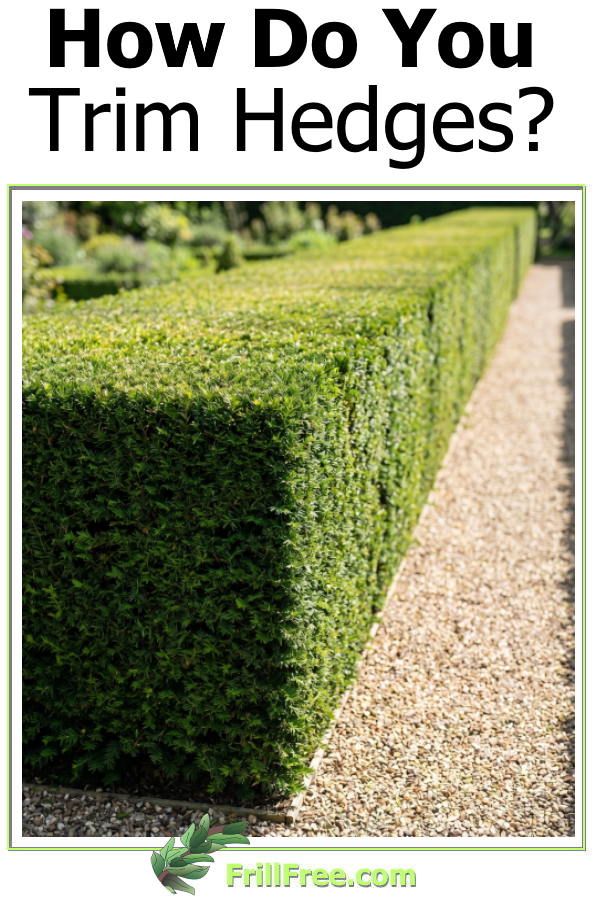
Trimming a hedge is one of those jobs that looks simple until you start. The good news is that with a little preparation and a steady approach, you can get a clean, healthy result without much stress.
Start by checking what kind of hedge you have and the right time to trim it.
Fast-growing formal hedges often need shaping once or twice during the growing season, while flowering hedges may need trimming after they bloom so you do not remove next season’s flowers.
Avoid trimming during very hot, dry weather or when birds may be nesting. In many places, wildlife organizations advise checking carefully for active nests before starting.
Next, gather the right tools. For small hedges, hand shears give excellent control. For larger hedges, electric or battery hedge trimmers save time.
You may also need loppers or secateurs for thicker branches, plus gloves, eye protection, sturdy footwear, and a rake or tarp for clippings. Clean, sharp blades make neater cuts and reduce plant damage.
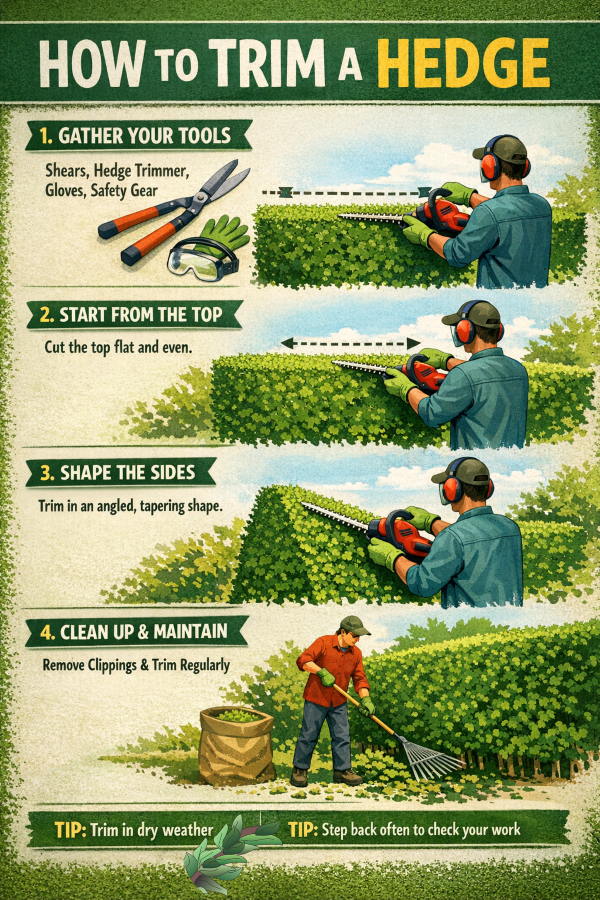
Before cutting, decide on the shape. A hedge should usually be slightly narrower at the top and wider at the base.
This tapered form allows sunlight to reach the lower branches and helps prevent the bottom from becoming thin and bare. If you want a very straight hedge, set up string lines as a guide: one across the top and one or two along the sides.
Begin with the sides. Cut from the bottom upward using smooth, even sweeps. Working upward helps the clippings fall away and lets you see the shape more clearly. Do not remove too much at once if the hedge is overgrown.
It is safer to trim lightly and step back often to check the line. Once both sides are even, trim the top. Keep your trimmer level and move slowly for a flat finish, or round the top slightly if you prefer a softer look.
If the hedge is badly overgrown, renovation may be needed. Some species tolerate hard pruning, but others do not recover well from being cut back into old wood.
Check the needs of your hedge before making drastic cuts. Renovating over two or three seasons is often safer than cutting everything back at once.
When you finish, clear away clippings, water the hedge if conditions are dry, and feed if appropriate for the plant type. Regular light trimming is usually better than infrequent severe cutting.
In short, trim at the right time, use sharp tools, keep the base wider than the top, and work slowly. That will give you a hedge that looks tidy and stays healthy.
So there you have it; if your hedge needs a trim, go ahead and do it, and don't be scared.
You might like these
Methods of Organic Farming - how it all comes together
Methods of Organic Farming...The ways and means of pulling the separate pieces into a cohesive whole...
Recycling in The Organic Garden; Re-Use and Re-Purpose
Re-Use and Re-Purpose; Frugal Gardening - Recycling In The Organic Garden...
Eco Friendly Lawn Care - transform your garden into a paradise
Transform your garden into a paradise - Eco Friendly Lawn Care...A Guest Post



 Jacki Cammidge
AUTHOR BIO
Jacki Cammidge is a Certified Horticulturist who helps gardeners grow more with less through low-input, budget-friendly gardening and propagation. She has gardened her whole life, served as head propagator at a wholesale nursery, and handled thousands of rose and juniper cuttings.
Readers can find her at Frill Free on Facebook and Pinterest. Her frill-free approach was forged in northern BC, where horse manure, leaves, salvaged sawdust, and a deer-tested raised bed built her garden from scratch.