- Frill Free Horticulture
- Growing Ornamental Plants
- Distilled Water for Pitcher Plant?
Jacki Cammidge is a Certified Horticulturist specializing in frugal, low-input gardening and propagation, with lifelong hands-on experience and years as a wholesale nursery head propagator.
Should You Use Distilled Water for a Pitcher Plant?
Why? And How Do You Do It?
I am a participant in the Amazon Services LLC Associates Program, an affiliate advertising program designed to provide a means for me to earn fees by linking to Amazon.com and affiliated sites. Other links on this site may lead to other affiliates that I'm associated with.
Many plants don't give a toss what kind of water you give them. But pitcher plants? Yes, they care and distilled water is the way to go.
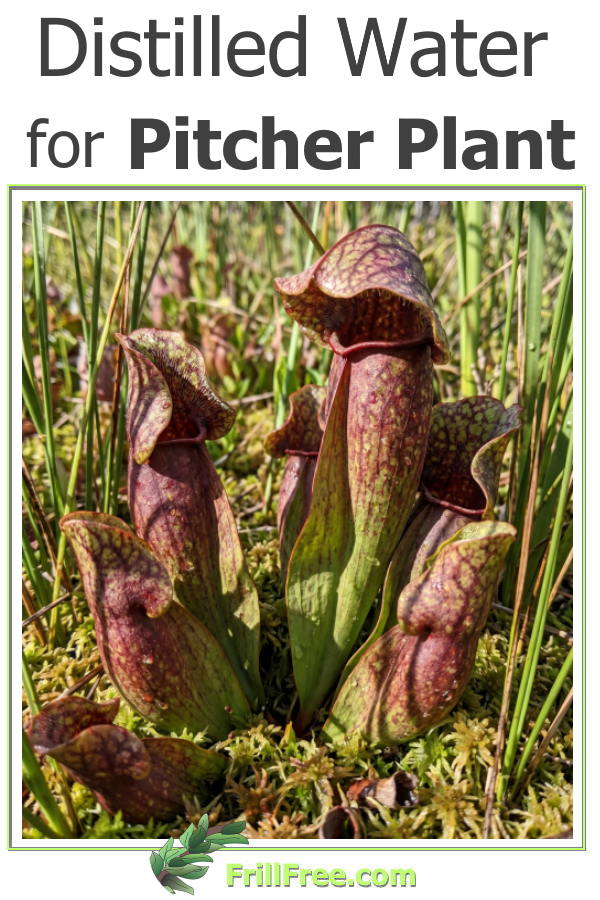
Distilled water is usually the safest and best choice for pitcher plants because these plants evolved in nutrient-poor, mineral-free bogs and rain-fed wetlands.
Their roots are not built to handle the dissolved salts, calcium, magnesium, chlorine byproducts, and other minerals often found in tap water.
Over time, those dissolved solids can build up in the soil and around the roots, causing stress, leaf browning, weak growth, smaller pitchers, and eventually root damage.
For that reason, most growers use distilled water, rainwater, or reverse-osmosis water instead of ordinary tap water.
Capture the water from the defrost cycle of many heat pumps or air conditioners. This is condensate, which is essentially distilled water.
If you are growing North American pitcher plants such as Sarracenia, distilled water works very well for routine watering.
The same is true for tropical pitcher plants in the genus Nepenthes and for cobra lilies and many sundews often grown alongside them.
Distilled water doesn't contain dissolved minerals, so it helps keep the potting medium from changing, making it help the plant live a long time without the need for repotting.
This matters because carnivorous plant mixes usually contain sphagnum peat, long-fiber sphagnum moss, perlite, or sand, and these mixes are chosen specifically because they stay low in nutrients. Mineral-rich water defeats that purpose.
For many pitcher plants, distilled water is not just acceptable but preferred. Sarracenia and similar bog plants are commonly grown using the tray method, where the pot sits in a shallow tray of distilled water during the growing season so the medium stays consistently damp.
Nepenthes are a little different: they like moist but airy media and generally should not sit in water constantly, but distilled water is still excellent for top-watering and for maintaining humidity without introducing minerals. In both cases, the key advantage is purity.
One important point is that "safe water" depends on total dissolved solids, often called TDS. Many growers aim for water below about 50 parts per million, and lower is generally better for sensitive carnivorous plants.
Distilled water is usually close to zero, which is why it is so dependable. If you want to know whether your tap water is usable, a TDS meter can give you a fast answer. Some growers with naturally very pure tap water can use it successfully, but unless you have tested it, distilled water is the safer default.
A common beginner question is whether to fill the pitchers themselves with distilled water.
For Sarracenia, the pitchers naturally collect rainwater, so adding a little distilled water to a newly opened or dry pitcher is fine, though not always necessary outdoors.
For Nepenthes, the pitchers already produce digestive fluid, so they usually do not need to be filled; if a pitcher is dry, a small amount of distilled water can be added, but only modestly.
If you try and grow your pitcher plant with anything other than distilled water, get ready for a disappointment. They require the particular conditions of a swamp or bog, and the water is a big part of it.
Distilled water protects the roots, preserves the right soil chemistry, and closely
matches the low-mineral conditions these plants experience in nature.
If you can emulate the specific environment they need, your pitcher plants and any other bog plant will be in seventh heaven. Give yourself a head start with distilled water for your pitcher plant.
 Jacki Cammidge
AUTHOR BIO
Jacki Cammidge is a Certified Horticulturist who helps gardeners grow more with less through low-input, budget-friendly gardening and propagation. She has gardened her whole life, served as head propagator at a wholesale nursery, and handled thousands of rose and juniper cuttings.
Readers can find her at Frill Free on Facebook and Pinterest. Her frill-free approach was forged in northern BC, where horse manure, leaves, salvaged sawdust, and a deer-tested raised bed built her garden from scratch.