- Frill Free Horticulture
- Growing Ornamental Plants
- Best Light for Tropicals
Jacki Cammidge is a Certified Horticulturist specializing in frugal, low-input gardening and propagation, with lifelong hands-on experience and years as a wholesale nursery head propagator.
Best Light for Tropicals
Bright, indirect light is one of the most important factors in growing tropical plants well indoors, because it most closely mimics the conditions many of these plants experience in nature.
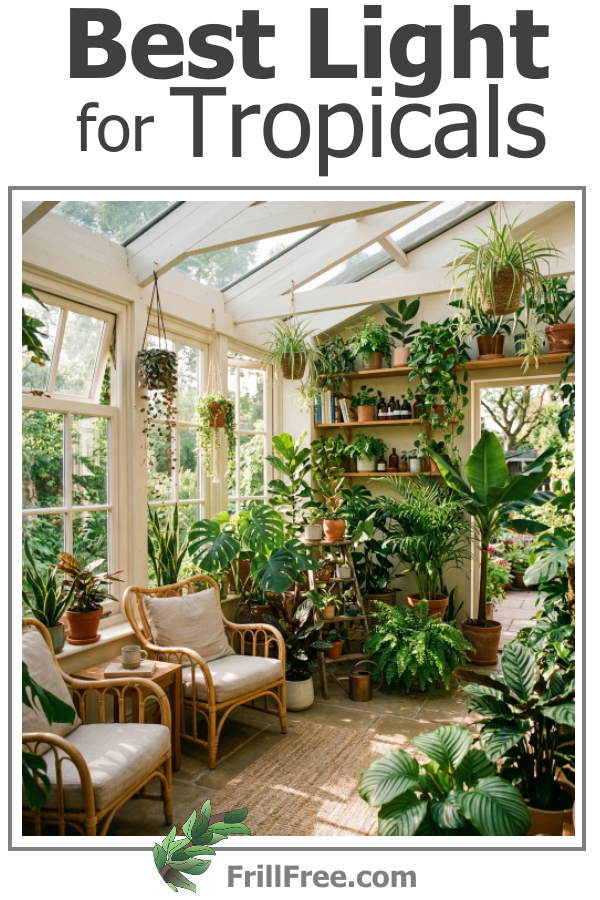
A lot of tropical plants grow beneath forest canopies. They receive plenty of light, but it is filtered through taller trees. That means they are adapted to strong ambient light, not necessarily hours of harsh, direct sun beating on their leaves.
Here’s a deeper look at how to provide bright, indirect light effectively.
1. Understand what "bright, indirect light" really means
Bright, indirect light means a space is well lit for much of the day, but the sun’s rays do not hit the plant directly with full intensity.
In practical indoor terms, this often means:
- near a bright window, but not pressed against glass in intense midday sun
- a few feet back from a south- or west-facing window
- directly at an east-facing window with gentler morning sun
- behind a sheer curtain that softens sunlight
- if your window has some kind of reflected light, that can add to the brightness too
The goal is high light without leaf scorch.
2. Know why direct sun can be a problem
Many tropical plants can handle some direct sun, especially in the morning. But intense afternoon sun, particularly through glass, can be too strong.
Too much direct sun can cause:
- bleached or faded leaves
- brown, crispy patches
- curled leaf edges
- heat stress
- faster drying of the soil
This is especially common with thinner-leaved plants like calatheas, ferns, and some philodendrons.
3. Learn the difference between window directions
Window orientation matters a lot indoors.
East-facing windows
- Usually ideal for many tropical plants
- Provide gentle morning sun
- Lower risk of leaf burn
South-facing windows
- Very bright for most of the day
- Great for light-loving tropicals
- Often need filtered light, especially at midday
West-facing windows
- Strong afternoon sun
- Can be too intense for sensitive plants
- Often better with sheer curtains or increased distance from the window
North-facing windows
- Usually provide the weakest natural light
- May work for low-light-tolerant tropicals
- Often not enough for vigorous growth in many species
4. Use distance from the window as a light control tool
You do not always need a different room or setup. Sometimes moving the plant just a little changes everything.
For example:
- right in the window: strongest light
- 1 to 3 feet away: bright but softer light
- farther into the room: moderate to low light
A tropical plant that burns on the sill may thrive a short distance back.
5. Filter harsh sunlight when needed
If your space gets strong sun, you can reduce intensity without depriving the plant of light.
Good options include:
- sheer curtains
- light-diffusing blinds
- placing the plant beside, not directly in front of, the window
- using other plants or furniture to break the strongest rays
This is especially helpful in summer, when sunlight is more intense.
6. Watch the plant for light-related stress signals
Plants tell you a lot if you know what to look for.
Signs of too much light:
- scorched or crispy patches
- pale or washed-out leaf color
- curling leaves
- rapid wilting despite proper watering
Signs of too little light:
- leggy or stretched growth
- smaller new leaves
- slower growth
- loss of variegation
- weak stems leaning toward the window
If a plant is not thriving, light is often the hidden issue.
7. Match light levels to the specific tropical plant
Not all tropicals want the same amount of light.
Plants that often like bright, indirect light:
- Monstera
- Philodendron
- Pothos
- Anthurium
- Ficus elastica
- Bird of paradise
Plants that may prefer gentler indirect light:
- Calathea
- Maranta
- Many ferns
- Peace lily
Plants with variegated leaves often need more bright light than green versions, because they have less chlorophyll.
8. Rotate plants for even growth
Indoor plants often lean toward their light source.
To keep growth balanced:
- rotate the pot every 1 to 2 weeks
- make small turns rather than drastic repositioning
- avoid rotating stressed plants too often if they are adjusting to a new spot
This helps maintain fuller, more symmetrical growth.
9. Adjust light seasonally
Indoor light changes with the seasons, even if the plant stays in the same place.
In winter:
- days are shorter
- sunlight may be weaker
- the angle of the sun is lower
- a plant may need to move closer to the window
In summer:
- light may become more intense
- the same spot may suddenly become too harsh
- filtering may become more important
Checking seasonal light shifts helps prevent both stretching and scorch.
10. Clean leaves so plants can use available light better
Dusty leaves do not absorb light as efficiently.
Best practice:
- wipe broad leaves gently with a damp cloth
- rinse suitable plants occasionally
- use a sprayer regularly but watch that droplets don't cause sunburn
- avoid heavy leaf-shine products
This is a small step that can make indoor light more effective.
11. Use grow lights if natural light is limited
If your home does not provide enough bright indirect light, a grow light can help.
A grow light may be useful if:
- you only have north-facing windows
- plants are far from natural light
- winter light is very weak
- you want more reliable growth year-round
For many tropical houseplants, a simple full-spectrum grow light placed at the right distance can make a major difference.
12. Avoid sudden light changes
A plant moved abruptly from low light to strong sun can burn quickly.
Instead:
- increase light gradually over several days
- monitor leaf response
- acclimate nursery plants before placing them in brighter spots
This is especially important after bringing home a new plant.
Simple rule of thumb:
Tropical plants usually want plenty of light, but softened light.
A good test:
If the area is bright enough to comfortably read in during the day without turning on lights, but the sun is not blasting directly onto delicate leaves for hours, that is often a strong candidate for bright, indirect light.
You might like these
Garden Plant Pots and Containers for deck and conservatory
Garden Plant Pots and Containers to grow tropicals, herbs, flowers and more...
 Jacki Cammidge
AUTHOR BIO
Jacki Cammidge is a Certified Horticulturist who helps gardeners grow more with less through low-input, budget-friendly gardening and propagation. She has gardened her whole life, served as head propagator at a wholesale nursery, and handled thousands of rose and juniper cuttings.
Readers can find her at Frill Free on Facebook and Pinterest. Her frill-free approach was forged in northern BC, where horse manure, leaves, salvaged sawdust, and a deer-tested raised bed built her garden from scratch.